
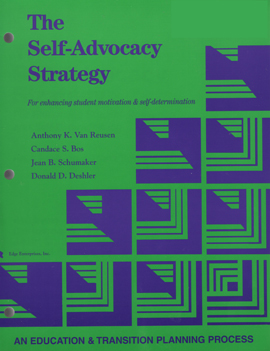
Publication Info: Edge Enterprises, Revised 2007
Self-Advocacy Resources
VIDEO
- Computerized Instruction of Learning Strategies - Paula Lancaster (Video) ppt deck
- Self Advocacy Strategy (Video)
PPTs
MORE
Self Advocacy Materials, August 2016 - Tony Van Reusen, Alex Chambers
- Education Inventory
- Education Worksheet
- Education Conference Model Cards
- Reading Skills List
- Instructional Sequence Flow Chart
- Personal Inventory
- Progress Chart
- Searching, Solving, Soaring, Self Advocacy Strategy presentation
- Simulated Education Conference Guide for Group Practice
- Transition Inventory
- Verbal Practice Checklist
Access Learning Strategy Checklists
Bullying and the Special Learner: Using Community Building Strategies and Self-Advocacy Strategy to Empower the Special Learner- PPT from 2018 KUCRL Conference, BB Mitchell (no video). IEP and Bullying doc
Description of Self-Advocacy from the SIM website
Stratenotes and Strategrams
- Strategram Vol. 7, No. 3, February 1995: Introducing the Self-Advocacy Strategy
- Strategram Vol. 8, No. 1, December 1995: IMAGINATION, The Key to Accomplishing Goals
- Strategram Vol. 8, No. 2, January 1996: The SHARE Game - Bernie Gabel
- Strategram Vol. 14, No. 6, August 2002: Self-Advocacy Revised
Research
-
Lancaster, P.E., Schumaker, J.B., & Deshler, D.D. (2002). The development and validation of an interactive hypermedia program for teaching a self-advocacy strategy to students with disabilities. Learning Disabilities Quarterly, 25, 227-302. This article describes a multimedia program designed to teach the Self-Advocacy Strategy to secondary students with disabilities. Research results showed the program was as effective as live instruction.
Oas, B.K., Schumaker, J.B., & Deshler, D.D. (1995). Learning strategies: Tools for learning to learn in middle and high schools. Secondary education and beyond: Providing opportunities for students with learning disabilities. Pittsburgh, PA: Learning Disabilities Association of America. This article uses student case descriptions to illustrate how a variety of learning strategies--including the Self-Advocacy Strategy, Sentence Writing Strategy, and Paraphrasing Strategy--might be implemented with students who experience an array of learning disabilities characteristics.
Van Reusen, A.K. (1998). Self advocacy strategy instruction 1 Enhancing student motivation, self-determination, and responsibility in the learning process. In M.L. Wehmeyer & D.J. Sands (Eds.), Making It Happen: Student Involvement in Education Planning, Decision-Making, and Instruction (pp.133-152). Baltimore, MD: Paul H. Brooks Publishing Co. This articles discusses the Self-Advocacy Strategy within the larger context of student motivation patterns.
Van Reusen, A.K., Deshler, D.D., & Schumaker, J.B. (1989). Effects of a student participation strategy in facilitating the involvement of adolescents with learning disabilities in the individualized educational program planning process. Learning Disabilities, 1(2), 23-34. This study investigated the effects of training adolescents with learning disabilities to use self-advocacy procedures during the Individualized Educational Program (IEP) conference.